












Change Your Brain,
Change Your Pain:
Understanding the Intersection
Between Physical and Emotional Pain… and How to Heal Both
The Hidden Intersection of Emotional and Physical Pain
I met Sam just hours after he had tried to take his own life. Once a decorated police officer, he was now trapped in unrelenting back pain after two high-speed accidents and six failed surgeries. He could not work, play with his kids, or sleep. He had lost his sense of purpose—and with it, his will to live.
Sam’s story is not unique. More than 50 million Americans live with chronic physical pain,1 and those who do are three times more likely to suffer from depression.2 Chronic pain and emotional pain are deeply intertwined, sharing overlapping brain circuits that can lock people into what I call the “Doom Loop”—a cycle where pain fuels despair, despair worsens pain, and hope slowly fades.
But neuroscience—and Scripture—tell a different story. Romans 12:2 (NIV) says, “… be transformed by the renewing of your mind….” Modern brain science confirms that renewal is not just metaphorical—it is physical. Your brain can rewire itself. With the right strategies, we can move from the self-perpetuating Doom Loop into the Healing Loop, a brain-based path toward peace, purpose, and freedom from suffering.
Why Pain Hurts So Much—In the Brain
Most people think of pain as purely physical, something that happens in the body. But in truth, pain is a brain experience. Whether it is a broken bone or a broken heart, your brain processes pain through three interconnected pathways:
- The Lateral Pain “Feeling” Pathway — your brain’s warning system that says, “Something’s wrong.”
- The Medial Pain “Suffering” Pathway — the emotional network that amplifies pain and adds fear, hopelessness, and despair.
- The Descending Pain “Inhibitory” Pathway — the brain’s braking system that quiets pain and restores calm.
When this final pathway is weakened—by trauma, stress, poor sleep, or toxic habits—the brain loses its ability to turn off pain. This is where emotional pain and physical pain merge. The circuits that process sadness, rejection, and grief are the same ones that process back pain, migraines, or fibromyalgia.
That is why people with depression often hurt physically—and why people with chronic pain frequently become depressed. Physical and emotional pain both sensitize and amplify each other—they feed one another, like a pair of monsters that never tire of causing you misery. The good news? If pain lives in the brain, healing can begin there, too.
When pain, anxiety, and negative thinking repeat day after day, they carve deep grooves into your brain, creating a Doom Loop that reinforces suffering.
The Doom Loop: Neuroplasticity Gone Wrong
Your brain is constantly rewiring itself based on your thoughts, emotions, and habits—a process called neuroplasticity. Unfortunately, this works both ways. When pain, anxiety, and negative thinking repeat day after day, they carve deep grooves into your brain, creating a Doom Loop that reinforces suffering.
The Doom Loop follows a predictable pattern I call PAIN-HQ:
- P – Pain Trigger: Something hurts—physically or emotionally.
- A – Activation: The brain’s “suffering” pathway lights up, flooding you with fear and despair.
- I – Invasion of ANTs: Automatic negative thoughts (ANTs) swarm in: “I’ll never get better.” “No one understands.”
- N – Nervous Tension: Muscles tighten, blood pressure rises, and pain intensifies.
- H – Harmful Habits: You reach for alcohol, junk food, or medication to numb the pain.
- Q – Quagmire: You feel stuck, hopeless, and disconnected—from others and from God.
Over time, the Doom Loop changes the brain’s wiring. The more it repeats, the easier it becomes to fall back into it. It is neuroplasticity gone wrong—a prison of your own neural pathways.
The Healing Loop: Neuroplasticity Gone Right
The same brain that can wire itself into pain can also rewire itself for peace. Healing begins when we activate the RELIEF Loop—a series of intentional steps that redirect brain circuits toward hope and restoration.
- R – Recognize and Address Triggers. Identify the biological, psychological, social, and spiritual causes of your pain. Chronic inflammation, unresolved trauma, loneliness, or loss of purpose are common culprits.
- E – Ease the Suffering Pathway. Calm your emotional brain through diaphragmatic breathing, hand warming, prayer, and relaxation techniques that quiet the limbic system.
- L – Let Go of Negativity. Kill the “ANTs”—automatic negative thoughts—by replacing them with truthful, hopeful ones.
- I – Initiate Relaxation and Emotional Expression. Tech-niques like journaling, eye movement desensitization and reprocessing (EMDR), or “Havening”—such as giving yourself a hug, which activates bilateral hemisphere stimulation—help release stored tension and trauma.
- E – Embrace Brain-healthy Habits. Exercise, sleep, good nutrition, and supplements like omega-3, curcumin, and magnesium strengthen the brain’s pain-inhibitory circuits.
- F – Foster Hope, Healing, and Faith. Hope is not just spiritual—it is also biological. It strengthens the prefrontal cortex, helping your brain apply the brakes on suffering.
The Healing Loop creates neuroplasticity gone right—a self-reinforcing cycle of healing. In our clinics, when patients follow these principles, 85% report significant improvement in both emotional and physical pain within six months.3
The Four Circles: A Whole-person Approach to Healing
Pain rarely has a single cause, which is why a single treatment seldom works. I encourage people to see their pain through four intersecting circles:
- Biological: How is your brain and body functioning? Are you sleeping well, eating well, and treating medical conditions that may fuel inflammation or pain?
- Psychological: What’s happening in your mind? Are trauma, guilt, or negative thinking patterns amplifying your suffering?
- Social: Who are the people around you? Lone-liness is toxic—it increases pain sensitivity and even mortality risk. Connection heals.
- Spiritual: Why are you here? When you lose meaning, pain multiplies. Reconnecting to purpose and faith restores resilience.
When all four circles are addressed, healing accelerates. When one is ignored, the Doom Loop often returns.
Faith and the Brain: Hope as Medicine
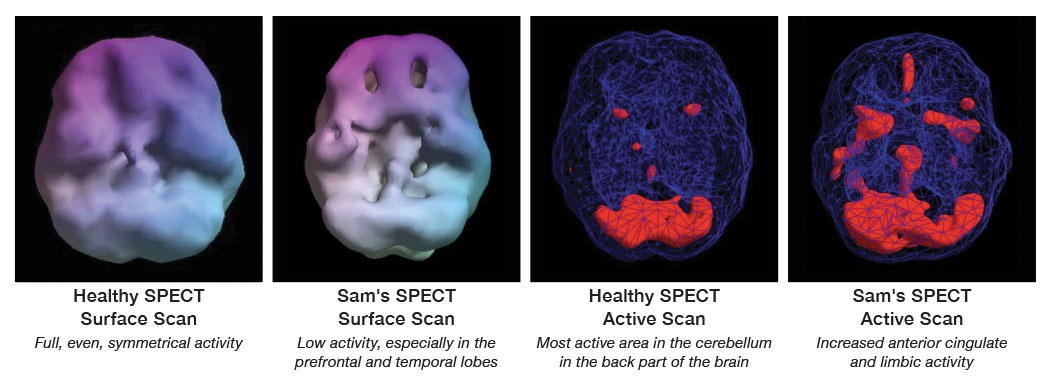
Science is finally catching up with Scripture. Philippians 4:8 instructs us to think about whatever is true, noble, right, pure, lovely, and admirable. Modern brain imaging, such as the nearly 300,000 SPECT (Single Photon Emission Computed Tomography) scans we have performed at Amen Clinics, shows that positive thinking and gratitude literally enhance blood flow to the prefrontal cortex—the part of the brain that calms the emotional centers and inhibits pain.
Prayer also quiets the medial pain “suffering” pathway. In one study, prayer was found to reduce activity in the same brain regions that light up during physical pain.4 Forgiveness, gratitude, and community worship—all staples of Christian life—activate healing circuits that restore both peace and perspective.
Hope, it turns out, is neurochemical. It releases dopamine, strengthens motivation, and rewires the brain to focus on possibility rather than despair.5 That is why the most powerful medicine I can prescribe is not just pharmacological—it is spiritual.
How Sam Found Relief
After months of working through the RELIEF Healing Loop, Sam’s life began to change. His brain scans before treatment revealed low activity in his prefrontal cortex—the brain’s braking system—and overactivity in the limbic system (the brain’s emotional centers) and anterior cingulate gyrus, the region that traps people in obsessive, negative thoughts.
With targeted therapies—diaphragmatic breathing, targeted supplements to calm the brain, therapy for his trauma, and a renewed faith in God—Sam’s brain function improved dramatically.
As his brain healed, so did his body. He reconnected with his wife and sons, went back to school, and rediscovered his purpose. The man who once sat in his garage ready to end his life now helps other first responders overcome trauma and pain. His suffering became his ministry.
Breaking the Stigma: “It’s Not All in Your Head”
Whenever I tell people that pain is processed in the brain, they sometimes bristle. They ask, “Are you saying it’s all in my head?”
Not at all. Pain is absolutely real—it is just that your brain is the organ that interprets it. Chronic pain is often a sign of a brain stuck in overdrive, not of imagined illness. The empowering truth is that if pain is processed in your brain, then you have the power to change it. You are not your pain. Your brain can heal.
From Doom to Hope
Pain—whether physical or emotional—does not have to define you. The same brain that locks you in suffering can lead you to healing. By understanding your brain, caring for your body, and renewing your mind through faith, you can rewire your life from the inside out.
Jesus said in John 16:33 (NIV), “… In this world you will have trouble. But take heart! I have overcome the world.”
The trouble is real. The pain is real. But so is healing. You can change your brain—and when you do, you can change your pain. ?
Endnotes
1. Lucas, J.W., & Sohi, I. (2024). Chronic pain and high-impact chronic pain in U.S. adults, 2023. National Center for Health Statistics Data Brief, No. 518, November 2024; doi: 10.15620/cdc/169630. ?
2. Vadivelu, N., Kai, A.M., Kodumudi, G., Babayan, K., Fontes, M., & Burg, M.M. (2017). Pain and psychology – A reciprocal relationship. Ochsner Journal, 17(2):173-180. PMID: 28638291. ?
3. Amen, D.G., Jourdain, M., Taylor, D.V., Pigott, H.E., & Willeumier, K. (2013). Multi-site six month outcome study of complex psychiatric patients evaluated with addition of brain SPECT imaging. Advances in Mind-Body Medicine, 27(2):6-16. PMID: 23709407. ?
4. Elmholdt, E.-M., Skewes, J., Dietz, M., Moller, A., Jensen, M.S., Roepstorff, A., Wiech, K., & Jensen, T.S. (2017). Reduced pain sensation and reduced BOLD signal in parietofrontal networks during religious prayer. Frontiers in Human Neuroscience, 11:337. doi:10.3389/fnhum.2017.00337. ?
5. Duncan, A.R., Jaini, P.A., & Hellman, C.M. (2020). Positive psychology and hope as lifestyle medicine modalities in the therapeutic encounter: A narrative review. American Journal of Lifestyle Medicine, 15(1):6-13. doi: 10.1177/1559827620908255. PMID: 33456415. ?
About the Authors
Daniel G. Amen, M.D., is a psychiatrist, neuroscientist, and founder of Amen Clinics, which has built the world’s largest database of functional brain scans related to behavior. He is a #1 New York Times best-selling author, and his latest book, Change Your Brain, Change Your Pain, explores how neuroscience, psychology, and faith intersect to heal both physical and emotional suffering.
Related Articles
Toxic Masculinity: Reclaiming What It Means To Be a Man
TOXICMasculinity:Reclaiming What It Means to Be a ManThe way I understand it, males (notice I did not say men) and females are different in at least three distinct ways—biblically, experientially, and empirically. First, when I say our amazing genders are different...

The Boy Crisis: The Evidence, Causes, and Solutions
The Boy Crisis The Evidence, Causes, and SolutionsWhat is the boy crisis? The boy crisis is global, predominately in developed nations. It is a crisis of: Mental health. As boys become young men, their suicide rate goes from equal to girls to five times greater.1 Boys...

Lonely Men: Why Disconnection is Costing More than We Realize
from the heartIn our work as Christian counselors, pastors, and caregivers, we sit with people in pain. However, there is a pain many men carry that too often goes unseen and unspoken: loneliness. It’s not just emotional. It’s spiritual. And it’s quietly doing heavy...

Reclaiming Masculinity: Helping Broken Boys Become Mended Men.
There are millions of us. We carry around leftover pain from childhood wounds. This unprocessed pain causes us to act out in ways that damage our relationships. We are easily offended, fragile, lash out, or withdraw. We are baffled by our behavior and unsure of what...

Paths from Fatherlessness to Father-fullness
Every culture faces an irrefutable challenge: the angst of fatherlessness. The stifling impact of fatherlessness and its corresponding consequences for children and culture are well documented.1 There is nowhere this is more evident and painful than in urban America,2 and yet we know fatherlessness is also wreaking havoc in the “safe suburbs.”

The Things He Can’t Talk About: Understanding the Hidden Struggles of the Masculine Soul
from the heartThere’s been a relentless attack on masculinity… on what it means to be a man from a radical agenda that seeks to redefine manhood as toxic and diminish anything distinctly masculine. As a result, men have been left to silently question their identity...