







reflections

Is it Time to Give the Mind its Decade in the Sun?
I began studying psychology in the 1970s, during the heyday of behaviorism. There were more than 50 professors in the psychology department of the major southern research university I was attending; 48 were card-carrying behaviorists, and the other two were closer to retirement than they thought.
When I returned to walk those halls in the 1980s, Ph.D. in hand, I hardly recognized the place. The cognitive psychologists had taken over. Now I realize that this type of makeover was not unusual. There were times when the department’s focus had been on relationships, whether it was from the Freudians of the 1940s or later attention given to family systems approaches.
The “feeling” folks had been the talk of the department in the late ‘50s and ‘60s. And today is all about the brain. The only aspect of the person that has not had its decade in the sun happens to be the most important part. The Bible uses the words “spirit,” “heart,” and “will” to describe this invisible, immeasurable aspect of human beings. I have learned to call it the CEO of the self.
To say the least, modern psychology has been fickle with its attachments and adamant in its rejections. Don’t get me wrong, I am a fan of modernism in general and modern psychology in particular. I certainly want my healthcare providers, air traffic controllers, and auto mechanics to be practitioners of precision. However, there is something essential to consider when it comes to the modern and ancient discipline of psychology—literally “soul-ology,” as you know. Let me illustrate with a story.
Dallas Willard loved to pose this scenario in class: “Imagine that there was a terrible accident on a Los Angeles freeway, and Mother Teresa and Robin Williams got into a head-on collision. Both were rushed to the University of Southern California Medical Center, but the physicians in charge decided that the only way to save either life would be to put the brain of Robin Williams in the body of Mother Teresa. Who is it that wakes up?”
Several different answers have been suggested. However, the general consensus seemed to point to either a very confused Robin Williams or, at the very least, a wisecracking nun. And that made Willard’s point. Most folks assume their identity can be found within the “wiring” of that three-pound piece of gooey flesh that floats between the ears. This illustration highlights the point of his riddle. What about the mind? This is the thinking and feeling aspect of our personhood, which most Christians throughout the ages believe to be both non-physical and eternal.
I have a good friend who is a well-recognized geneticist from England. She spent her career consulting with her patients concerning the sometimes pleasant, but most often painful, implications of the DNA codes. She was also a fan of Dallas Willard. After doing a slow reading of his psychology text, Renovation of the Heart, a light bulb turned on over her head. She said this to me: “You know, there was not one thing that Willard said about the soul that could not also be said about a person’s DNA. Both are organizing, synthesizing, and re-creating features that make you, you.” Now, she was not suggesting that DNA and the soul are equivalent. But she was musing as to whether one’s DNA is to one’s bios (biological) life what the soul is to one’s immaterial, eternal, zoe (spiritual) life.
Over the years, the implications of stories like these have caused me to hope that the discipline of psychology will eventually get around to shifting its focus to aspects of the person that cannot be seen or measured. From the perspective of Christianity, and most world religions, human beings are amphibious creatures, containing the intertwining of both bios and zoe stands of life.
In Genesis 2:7 (NKJV), we read, “And the Lord God formed man of the dust of the ground, and breathed into his nostrils the breath of life; and man became a living being.” However, there is much more going on here than Adam taking his first gulp of air. This sixth movement, or epoch of creation, occurs after many created things have already come to life and are breathing. Trees and bushes were already “breathing.” Lions and antelopes were already running around, getting winded, and sucking in air. So, for this crescendo moment with God’s precious image bearer, God must have “breathed” into Adam something very different than O2, especially since God does not breathe.
This breath from God made Adam a living soul. God, I believe, filled Adam with zoe life, a life that can be full (John 10:10) and eternal (John 17:3). But you know what happened next; it was the “great unplugging” from the Tree of Life. And with this choice to know life apart from God, death entered the world, and life became short, difficult, and a dark new reality for Adam, Eve, and all future image bearers.
From the perspective of Christianity, and most world religions, human beings are amphibious creatures, containing the intertwining of both bios and zoe stands of life.
Much later in Scripture, this story repeats. After Jesus enters earth-life and turns the world upside down by demonstrating His power over death—power to undo the great unplugging—He brings the disciples back to Genesis 2:7. John, the great theologian of the Church, understands the significance of one of Jesus’ last actions before appearing to leave earth by stepping back outside of the three-dimensional space. John writes: “… He breathed on them, and said to them, ‘Receive the Holy Spirit’” (John 20:22, NKJV). That is, take into yourselves, the zoe-life-giving personal power of the Trinity.
The same type of “breath” given to humankind back in the Garden became available once again because of the incarnation, life, death, and resurrection of Jesus. We now live in an age where there is new access and availability to the energies of God’s life. The Kingdom is here.
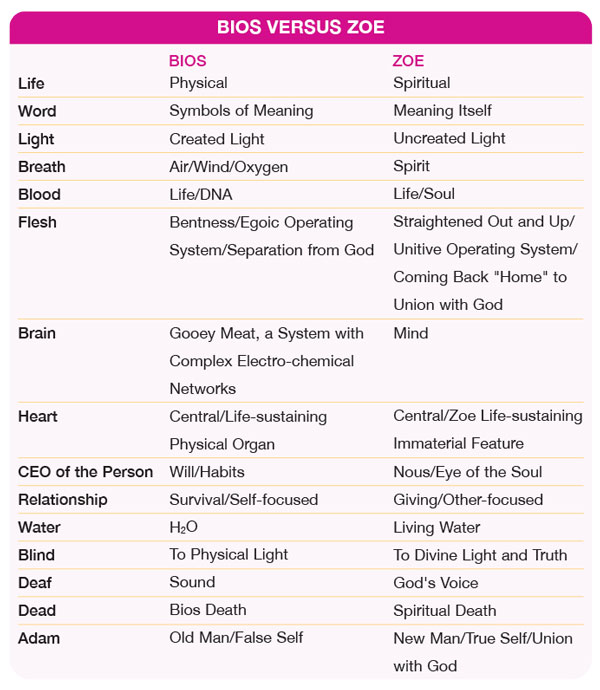
Our bios life is a great and wonderful gift; our bodies are magnificent, fantastic works of functional art. Our bodies give us independence, a kingdom, if you will. But the even greater treasure is the zoe life that we share to some extent with the Trinity. That is the “treasure in earthen vessels” that Paul references in 2 Corinthians (4:7). It is the part of you that can exist forever.
When Jesus heals blind eyes, that is remarkable. But it is also a clue as to His mission within the mission. He came not so much to restore sight to a few fortunate folks, but to make the invisible real, visible to all. Jesus’ life and ministry were a demonstration of, a fulfillment of, and a focus on zoe life, which exists deep within and all around our bios life. That is the blindness He came to cure; and that is the life He came to offer.
Not convinced? Take some time to slowly read the parallel columns, which highlight the similarities and differences between the two forms of life that exist within you.
We are amphibious creatures. Jesus, the Incarnate One, knows this very well and is concerned about both of these marvelous aspects of you. However, his greatest concern is for the part of you that can live forever in fellowship with the Trinity.
Modern science has made remarkable progress in the bios-life sciences. In time, I believe, the “three-dimensional” chess board they play on will be mastered, but Christians know something about the zoe-life sciences. The devotion masters know quite a lot. They know that with the zoe-life sciences, the game is played on a four-, five-, or maybe even 12-dimensional board. It’s all brain-blowing, really, when you put your mind to it.
I look forward to the day when universities will catch up with the Church and turn their attention to the invisible, immeasurable, and real—the Great Life—in which we all live and move and have our being (Acts 17:28). ?
About the Authors

Gary W. Moon, M.Div., Ph.D., served as the founding Executive Director of the Martin Institute for Christianity and Culture and the Dallas Willard Center for Christian Spiritual Formation at Westmont College. He continues to direct their resource development initiatives by serving as the director of Conversatio Divina: A Center for Spiritual Formation, www.conversatio.org.
Related Articles

A Place to Thrive
leadership psycEditor’s Note: The entire American Association of Christian Counselors (AACC) family mourns the loss of our dear friend and supporter, Dr. Gregory Jantz. He was a professional mental health pioneer in whole-person care and a treasured family man. As the...

Latest Developments Under a New Administration and Their Impact on Christian Counselors
law, ethics, & liabilityIn 2025, Christian counselors stand at the crossroads of faith and law in an increasingly complex cultural climate. Of course, the changing political environment also impacts the Christian counseling climate. Recent changes, while untested,...

The Path to Human Flourishing
from the heartOne of the most striking trends in mental healthcare today is the growing sense of pace, pain, and pressure that so many people are facing. In the middle of it all, a few honest questions keep rising to the surface for those we work with. “Why am I...

The Dangers of Doomscrolling on Mental Health
Doomscrolling is an increasing mental health concern but not an entirely new issue. An entry in the Merriam-Webster Dictionary defines it as “spending excessive time online scrolling through news or other content that makes one feel sad, anxious, angry, etc.” Let’s go...

Combating the Loneliness and Social Isolation Epidemic through Connection and Community
According to the World Health Organization (WHO), “The effect of social isolation and loneliness on mortality is comparable to that of other well-established risk factors such as smoking, obesity, and physical inactivity” (2025, para. 2). From adolescents to seniors,...

The Great Disconnect: Digital Insanity and the Path to Wellness
Have you experienced this term I am calling “digital insanity?” Digital insanity is what happens when technology no longer serves us but instead controls, shapes, and fragments our lives. After writing The Digital Invasion: How Technology is Shaping You and Your...

The Neurobiology of Trauma and Social Isolation: Rising Above the Crisis
While social isolation and trauma are two distinct experiences, we know there is a connection. Recent research and advances in our understanding of the neurobiology of trauma have revealed a more complex and interactive relationship between social connection, trauma,...

Relational Wisdom: A Biblical Framework for Overcoming Loneliness in a Disconnected Age
The Crisis Behind the Smile Loneliness is not always visible. Yet, for many, the ache of disconnection is both real and persistent. As a professor in a graduate social work program and a biblical counselor, I regularly meet individuals who describe feeling “surrounded...

Godless: Recognizing the Hidden Realities of Spiritual Abuse that Could Lead to Isolation
With my hands shaking, jaw locked, and stomach in knots, I entered the church looking for the closest exit. After a long hiatus from the church world, I was only there to support my husband, a care pastor at another church. The impact of the spiritual abuse I endured...
Loneliness in the Church: The Desperate Need to Belong
“… It is not good for the man to be alone….” – Genesis 2:18, NASB His message came from an e-mail… two lines, no greeting. “I don’t belong anymore. I’m not sure I ever did.” Jeremy had been an usher for years, was a regular with one of the men’s Bible studies, and was...